
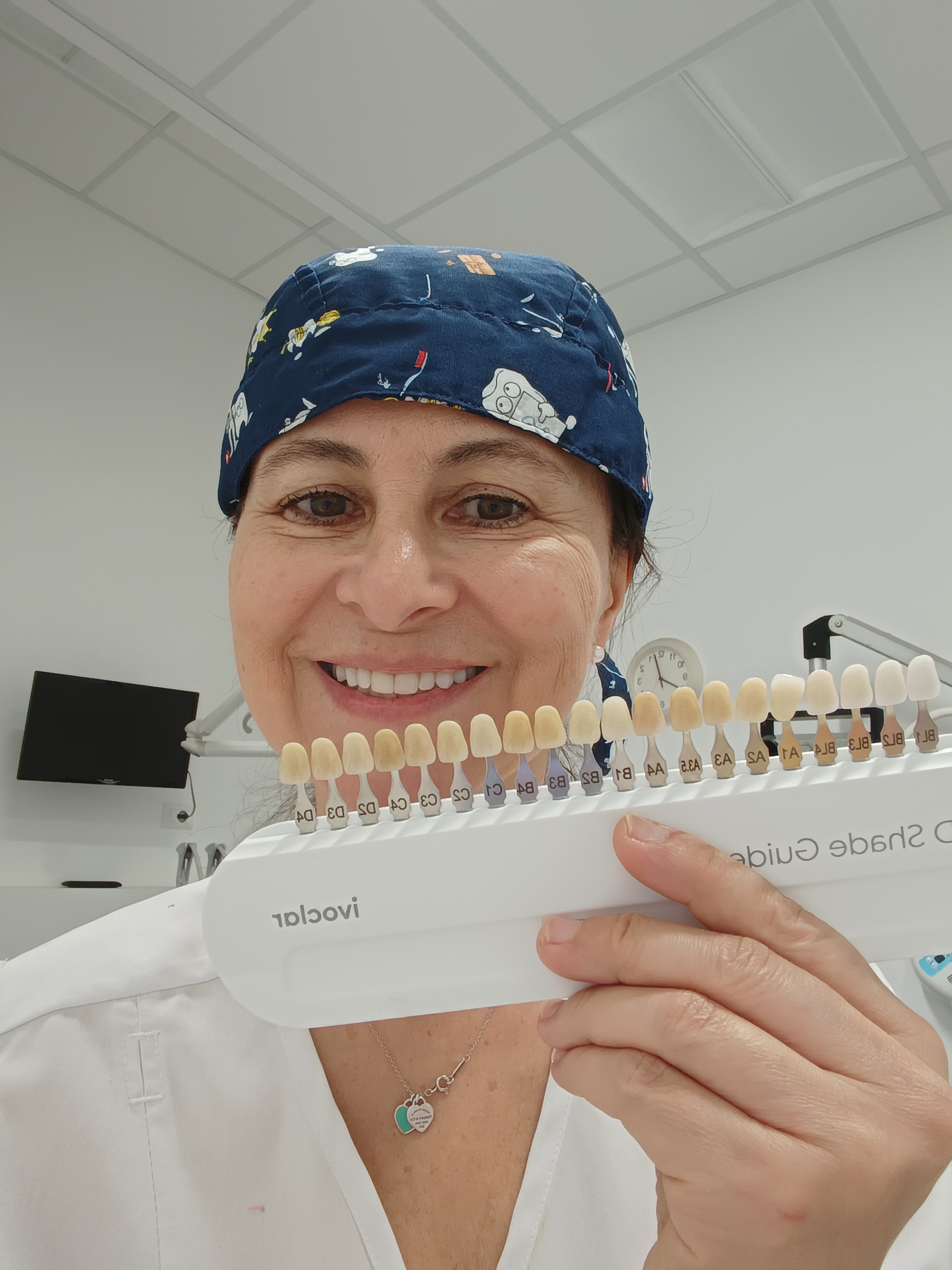
Having a bright, healthy smile is everyone’s wish. Often, though, before taking the big step, a thousand questions arise: Does it hurt? Does it damage enamel? How long does it last?
In questa guida pratica rispondo alle 10 domande frequenti sullo sbiancamento dentale che gli utenti cercano più spesso su Google. Scopri tutto quello che c’è da sapere per illuminare il tuo sorriso in totale sicurezza!
1. What is teeth whitening?
Teeth whitening is an aesthetic and medical treatment that uses peroxide-based gels, such as hydrogen peroxide or carbamide peroxide, applied to the surface of the teeth.
These agents release oxygen free radicals, which penetrate the enamel and dentin, promoting a chemical reaction that alters the structure of the organic pigments present in the teeth. The result is reduced color saturation and increased tooth brightness, making teeth lighter and with a cleaner, more youthful look.
2. Does teeth whitening replace teeth cleaning?
No. It is important to stress that teeth whitening is not a cleaning procedure, since it does not remove stains or tartar mechanically; rather, it chemically alters pigments, making them less visible.
Professional teeth cleaning (scaling) removes external physical deposits and bacteria, while whitening acts on the shade of the tooth’s internal color. The two treatments are complementary, and cleaning should always be done before whitening.
3. Why is whitening done?
Teeth whitening is performed mainly for aesthetic reasons and is one of the most requested treatments in dental practices.
The main reasons for choosing it are:
- Improved self-esteem and satisfaction: it gives whiter, brighter teeth. This increases the patient’s confidence in their appearance and improves quality of life, as confirmed by scientific studies on the psychological impact of the treatment.
- Conservative and minimally invasive treatment: it is an aesthetic alternative that does not involve filing down or wearing away the tooth structure. It is therefore much more conservative than applying veneers or crowns.
- Effective on different types of stains: it is indicated for teeth that have yellowed or darkened due to diet, smoking, aging, trauma, or necrosis of the dental pulp.
- Preparation for prosthetic or restorative treatments it can be performed before new aesthetic fillings or veneers. In this way, a lighter base is ensured for a perfect final shade result.
- Fast and effective results: it offers a visible change in a very short time, without the need for anesthesia or invasive surgical procedures.
4. Who can get teeth whitening?
Teeth whitening can be performed on healthy adult patients who wish to improve the aesthetics of their smile
5 Are there contraindications?
- Pregnant and breastfeeding women: as a precaution, it is recommended not to perform whitening during pregnancy or breastfeeding, even though there is no clear scientific evidence of a direct risk.
- Patients with a clinical history of tumors: in these cases the treatment should be avoided.
- Under 16 years of age: due to the larger dental pulp volume and the root apex still forming, whitening should be postponed until after turning 16.
- Presence of cracks or dentin exposure: cracks in the enamel or exposed tooth necks are a contraindication to treatment.
- Unrealistic expectations: patients who want shade results incompatible with what the clinical technique can actually offer may not be good candidates.
- Please note: The gel has no effect on fillings, caps, crowns, or ceramic veneers. If you have visible restorations, you may need to replace them after treatment to match the color.
"Does the treatment have side effects? How long do the results last? You can find all the answers in the Second Part of my teeth whitening guide