
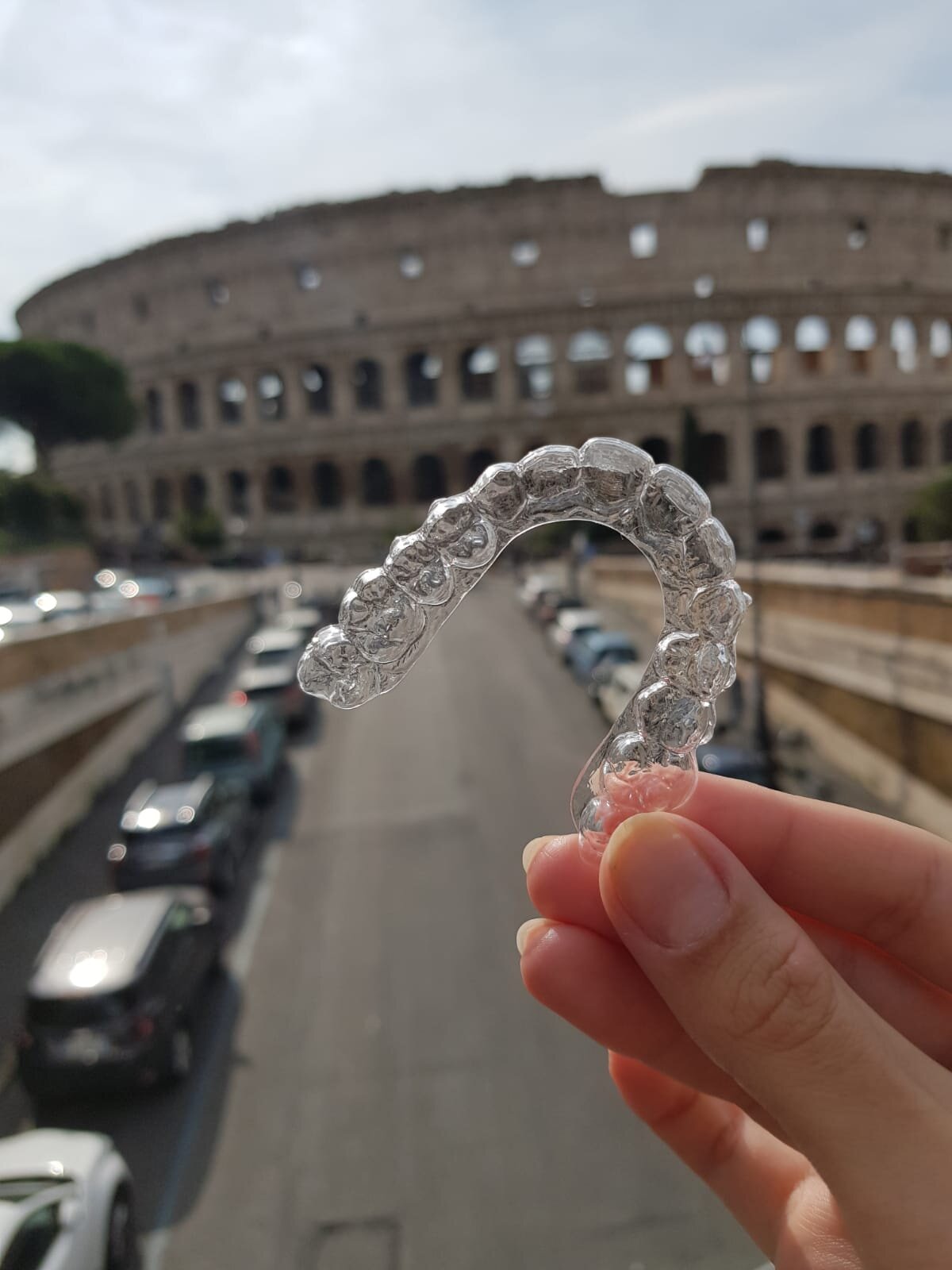
Clear Aligners for Adults: 34 Answers to Your Questions
Article written and reviewed by Dr. Roseli Dall'Armellina, Registered with the Register of Dentists of Rome.
Deciding to align your teeth in adulthood raises many questions, both aesthetic and clinical. Often patients spend hours looking for answers, risking finding misleading commercial information or DIY treatments that are very dangerous for oral health.
To provide full medical clarity, I have collected in this article the definitive checklist with the 34 most common doubts in online searches.
The key doubts: do they really work and are they suitable for an adult?
1. Do aligners really work in adults? Yes, they are a scientifically tested and effective treatment option in suitable cases, provided the patient is compliant.
2. Are they only cosmetic? No. They move teeth biologically through a computer-planned sequence; proper therapy assesses chewing and function, not just visible aesthetics.
3. Are they better than fixed metal braces? There is no absolute winner. They offer discretion and hygiene, but traditional fixed braces can be more predictable for very complex tooth movements.
4. Are they suitable at 40, 50 or 60? Absolutely yes. Chronological age doesn’t matter; what matters is the health of teeth, bone and gums.
5. Can they correct crowding, spaces and bite problems? Yes, in mild to moderate cases. Severe cases or major jaw discrepancies may require auxiliaries or traditional fixed techniques.
6. Can they fix an old relapse after already having braces when younger? Yes, it’s one of the most common reasons for use, but the cause that shifted the teeth again must be identified first.
7. Will they change the shape of my face, lips or jaw? Aligners move teeth, not facial bones. Any small changes depend on the specific case and are not a standard effect.
8. Can they solve headaches, jaw clicking or bruxism? It shouldn’t be taken for granted. Temporomandibular joint disorders require a separate diagnosis and are not automatically cured by aligning the teeth.
Everyday life doubts: pain, speech and habits
9. Do they hurt? It’s normal to feel a sense of pressure or mild soreness for 1–3 days after wearing a new aligner, a sign the device is working.
10. Will I speak well at work, in public or on video calls? At first, a very slight and temporary change in the pronunciation of some sounds may appear, which disappears within a few days.
11. Can you really see them when I smile? They are extremely discreet and far less visible than metal brackets , but up close you may notice the small composite attachments applied to the teeth.
12. Can I kiss, talk and sleep normally? Yes, everyday life continues without issues. The device is custom-made and stable.
13. How many hours a day do I need to wear them in total? International clinical guidelines strictly require 20 to 22 hours a day.
14. Can I take them out whenever I want? Being removable they offer flexibility, but they should be removed only for meals and to brush your teeth, not for long personal breaks that would compromise the result.
15. Can I eat and drink with the aligners on? No. To eat they must always be removed. With the aligners in, you can drink only still water.
Coffee, tea, wine or sugary drinks stain the device and increase the risk of cavities if trapped under the aligner.
16. Can I chew chewing gum? No, it’s not recommended because the gum sticks to the plastic material damaging it.
17. Can I smoke with the invisible appliance? Smoke yellows and stains the aligners quickly, and also reduces the health of the gum tissues essential for the therapy.
Practical doubts about the process: timing, check-ups and setbacks
18. How long does the whole treatment last? There is no universal duration. It varies from 6 to 24 months depending on the biological complexity of the case and the actual hours of wear.
19. How often do you change the aligner at home? Usually every 1 or 2 weeks, following the exact biological pace prescribed by the dentist.
20. Do I need in-office check-ups if I already have all the aligners at home? Absolutely yes. Tooth movement is a complex medical process that requires in-person professional supervision to verify that everything proceeds as planned.
21. What are attachments (or “attacchi”)? They are small composite-resin bumps in the same color as the tooth, applied temporarily to give the aligner grip and perform complex movements.
22. Why did they tell me I might need elastics? Intermaxillary orthodontic elastics are used in cases where it is necessary to guide and correct the proper bite closure between the two arches.
23. Do I have to file my teeth or have extractions to make space? In some treatment plans, a minimal interproximal enamel reduction (stripping) or, in rare complex cases, extraction may be necessary, but it is not an automatic rule.
24. What happens if I lose, break, or forget an aligner while traveling? You should never decide on your own whether to move to the next one or go back to the previous one. You must contact me immediately to receive the correct clinical instructions.
25. If I don’t wear it for a few days, can I make up the lost hours? Skipping days alters the plan and the fit of the plastic on the teeth. The course of action must be agreed with me.
26. Are X-rays or scans needed before starting? Yes, a serious case work-up always includes a panoramic X-ray, cephalometric X-ray, clinical photographs and 3D digital scans of the arch or impressions.
27. Do I need to wear a retainer at the end of treatment? Yes, final retention is mandatory and essential. Without retention retainers (fixed or night-time), teeth biologically tend to return to their original position.
Doubts about medical safety, gum health and risks
28. Do aligners damage teeth or gums? No, if the therapy is planned and supported by excellent hygiene. If, instead, the trays are placed on dirty teeth or with tartar, the risk of cavities and gingivitis increases drastically.
29. Can I start if I have gingivitis, periodontitis or bone loss? Before moving teeth, the supporting tissues must be perfectly stable and healthy. Any active inflammation must be treated before starting orthodontics.
30. If I have dental implants can I wear invisible braces? Implants are osseointegrated and cannot be moved. The computerized digital plan must be built around the implant, moving only the surrounding natural teeth.
31. Is there a risk that tooth roots shorten (resorption)? It is an inherent and known risk of any orthodontic treatment. For this reason, preliminary X-rays and constant professional monitoring are needed, avoiding commercial treatments without a doctor.
32. Are aligners safe in the plastic materials used? Yes, certified professional medical devices are made of top-quality biocompatible polymers, safe for the oral mucosa.
33. Does pregnancy prevent starting treatment? No, pregnancy is not an absolute contraindication, but gum health but gum health (subject to hormonal swings) must be monitored with extreme care throughout the orthodontic journey."
How can you get an honest, no-surprises quote in Rome?
Low-cost prices or “starting from” offers often seen in online ads are a trap that hides the lack of in-person medical check-ups. A proper quote for an invisible orthodontic treatment must be clear and include everything: the initial case assessment, the full sequence of required aligners, all monthly in-office check-up visits, and the final retention devices.
The best question to ask is not whether aligners work, but which treatment plan is safest and most predictable for the specific health of your mouth, your gums, and your bite. A serious answer and an accurate quote require a thorough, personalized clinical visit.
🦷 Information Transparency and Clinical Protocols
This content is for information purposes only, to address patients’ general questions about orthodontic treatments in adults. The article was written and reviewed by Dr. Roseli Dall'Armellina, Dentist in Rome (San Giovanni area). If there is pre-existing tooth mobility, gingivitis, or chewing issues, a personalized medical diagnosis is required.
Do you want to assess whether treatment is feasible for your smile and get a safe treatment plan? To avoid risks and plan your in-office therapy, contact me directly on WhatsApp to book your diagnostic visit in Rome San Giovanni.